Transform your short term fitness goals into life-changing results.

Deep Health coaching goes beyond nutrition and fitness to address your greatest health and wellness challenges on a deeper level.
If what you’ve always done is no longer working for you, it’s time to look at your Deep Health.
The Problem
Your health is connected. Your approach should be, too.
If you’re a driven individual in midlife, you’ve probably already tried the fixes. You’ve cut calories, pushed harder in workouts, tried a sleep hack, downloaded a meditation app, and promised yourself you’d slow down once things calmed down.
Some of it helped for a while. Then the exhaustion came back, because most health advice treats nutrition, fitness, sleep, and stress as separate problems. In your body and your life, they’re one interconnected system.
Poor sleep makes stress harder to manage. Chronic stress changes how you eat, how you recover, and whether you keep showing up for workouts. Skipping workouts affects your energy, your mood, and your sleep. Round and round it goes.
You can’t out-train, out-diet, or out-schedule a system that’s depleted. You have to understand how it fits together, and that’s what Deep Health does.
The Six Dimensions of Deep Health
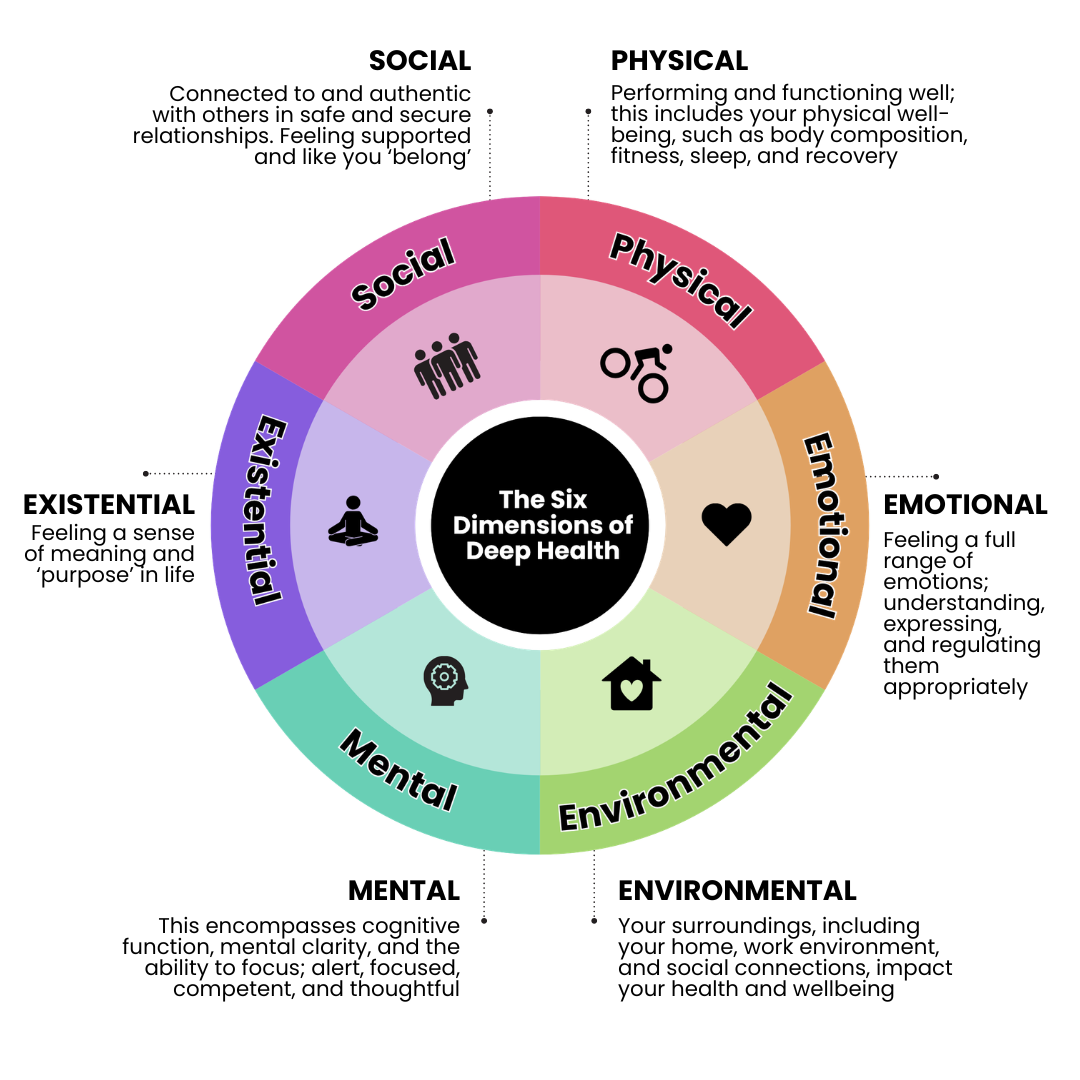
The Deep Health approach considers six interconnected dimensions of health that influence how you feel, function, and recover.
Understanding how these areas affect one another can help you identify the underlying obstacles to your well-being and where to focus your efforts.
Physical Health: Movement, nutrition, sleep, and recovery practices that support your energy and performance.
Mental Health: Thought patterns, beliefs, and behaviors that influence stress, focus, and decision-making.
Emotional Health: Developing awareness and regulation skills to navigate challenges without constantly operating in survival mode.
Relational Health: Building boundaries, connection, and support systems that protect your well-being.
Environmental Health: Creating routines, spaces, and systems that make healthy choices easier.
Existential Health: Aligning your daily actions with your values, purpose, and the life you want to create.
Why the Dimensions Matter Together
Your health cannot always be understood by examining one dimension in isolation.
Consider what happens when work becomes increasingly demanding. Stress may disrupt your sleep, leaving you fatigued and less inclined to exercise. As your energy declines, meal planning and other healthy routines may become harder to maintain. With little time left for relationships, recreation, or personal priorities, the strain can extend well beyond the workplace.
Addressing sleep, nutrition, or fitness can help. But understanding the demands contributing to the pattern may reveal additional opportunities for change.
The connections work in positive directions, too. Improving sleep can make exercise more manageable. Establishing boundaries can create space for recovery. A supportive relationship can make difficult changes easier to sustain.
The goal is not to optimize every dimension at once. It's to understand how they interact and determine where your attention can make the greatest difference.
Your health doesn't happen separately from your life.
The six dimensions are not six independent categories to check off a list. They are interconnected aspects of your experience, and their influence becomes clearer when you consider your day-to-day circumstances.
Here are a few examples of what that can look like.
When work affects your physical health
Long hours and persistent work stress can disrupt sleep, limit opportunities for movement, and make consistent nutrition more difficult. The physical effects may be what you notice first, but your workload, boundaries, and daily environment may also deserve attention.
When your environment shapes your habits
If your schedule leaves no room for meal preparation or your workspace encourages you to remain sedentary for hours, healthy choices require more effort. Adjusting your routines and surroundings can reduce that friction and make healthy behaviors more practical.
When emotional strain affects your relationships
Persistent stress can leave you feeling irritable, withdrawn, or less patient with the people around you. Recognizing the strain and developing healthier coping strategies can support both emotional well-being and the quality of your relationships.
When your priorities and daily life fall out of alignment
You may value your health, family, faith, or personal growth while spending most of your time and energy meeting external demands. That disconnect can leave you feeling depleted or dissatisfied. Examining your priorities and how you allocate your resources can help you bring your daily life into closer alignment with what matters.
When poor sleep affects your emotional health
Consistently getting too little sleep can make it harder to regulate emotions, manage frustration, and respond calmly to everyday stressors. Over time, this can leave you feeling more emotionally reactive and less equipped to navigate challenging situations.
When boundaries affect your physical health
Difficulty saying no to additional responsibilities can leave little time for exercise, meal preparation, or adequate rest. What looks like a struggle with healthy habits may also reflect a pattern of prioritizing other people's demands over your own basic needs.
When financial stress affects your mental health
Ongoing financial pressure can occupy your attention, fuel worry, and make it harder to concentrate or make decisions. Even when other areas of life are going well, persistent concerns about financial security can place a significant strain on your mental well-being.
When physical health affects your existential health
A health setback or loss of physical capacity can disrupt activities that once gave your life meaning, from pursuing a challenging career to participating in a beloved sport. Adjusting to these changes may involve redefining what fulfillment looks like and finding new ways to stay connected to your values and purpose.
These are examples, not formulas. The same challenge can have different influences for different people, which is why understanding your individual circumstances matters.
How the Method Informs Coaching
An integrated approach to the health challenges you’re facing now.
Deep Health provides the framework for understanding your overall well-being. Coaching applies that framework to your goals, circumstances, and the areas where you want to make progress.
For many busy individuals, the most immediate concerns involve stress and burnout, sleep, nutrition, and fitness. These areas are closely connected to physical health, but they are also influenced by the other dimensions of Deep Health.

Stress & Burnout Recovery
Understand the patterns contributing to persistent stress and work toward a more sustainable relationship with your responsibilities. Coaching can help you develop practical coping strategies, establish boundaries, prioritize recovery, and build habits that support your well-being beyond a temporary break from work.
Sleep Improvement
Explore the routines, environmental factors, and stress-related habits that may be interfering with consistent rest. Develop a more supportive approach to sleep that fits your schedule and daily life, while recognizing when a sleep concern warrants medical evaluation.

Nutrition Coaching
Build eating habits that support your health, energy, and goals without relying on extreme restrictions or rigid rules. The focus is on practical, sustainable behaviors that work with your preferences, responsibilities, and circumstances.
Fitness Coaching
Develop a training approach that reflects your goals, current fitness, and recovery capacity. Whether you're rebuilding consistency, improving strength, or returning to exercise after a demanding period, the objective is to make movement a sustainable part of your life.
These are not isolated programs that ignore the rest of your life. They are applications of a broader approach that considers your individual needs and the factors influencing your ability to make lasting changes.
We begin with what matters most to you, then account for the wider picture as your plan develops.
My Coaching Approach to Deep Health
Evidence-informed guidance. Individualized behavior change.
I'm Michelle Porter, a National Board-Certified Health & Wellness Coach (NBC-HWC), NASM Certified Personal Trainer, and experienced health and fitness professional.
My approach brings together health coaching, nutrition, fitness, sleep and stress education, and behavior change. My background also includes working with organizations on performance and employee wellness, giving me an appreciation for the demands and systems that influence how people function at work and in their lives outside it.
As a coach, I help you translate health knowledge into practical action. That means understanding your goals, identifying the behaviors and circumstances influencing your progress, and developing strategies you can realistically maintain.
My role is not to prescribe a perfect lifestyle or tell you to simply try harder. It is to help you make informed decisions, build the skills to follow through, and develop an approach to your health that can evolve with you.
Coaching complements, rather than replaces, medical care and mental health treatment. When a concern falls outside my professional scope, I encourage appropriate support from qualified healthcare providers.
Who Deep Health Coaching is For

Ambitious people who want their health to support the life they're building.
This approach is particularly relevant to busy professionals and high achievers in midlife who have spent years managing competing demands and are ready to give their health more deliberate attention.
You may be navigating chronic stress, struggling to maintain your routines, noticing changes in your energy or fitness, or realizing that the strategies that once worked no longer fit your current life.
You don't need to have every dimension of your health figured out—or be struggling in all of them.
You need a willingness to examine where you are, understand what matters to you, and take practical steps toward change.
Deep Health coaching helps you move beyond a collection of disconnected health goals toward an approach that accounts for the person you are, the life you're living, and the health you want to build for yourself.
Start With Free Resources
Whether you're looking to better understand deep health or you're ready to begin making changes, these free resources will help you take the next step.
-

Take the Stress & Burnout Assessment
Get a clearer picture of where you stand with chronic stress.
This comprehensive assessment helps you evaluate your current stress and well-being, identify the areas of your life most affected, and pinpoint where to focus your efforts. Understand your starting point and get a clearer sense of what needs your attention.
-
Follow the Burnout Recovery Workbook
A DIY practical guidebook for finding your way forward from burnout.
You don't need a coach to start making meaningful changes. This step-by-step roadmap walks you through the key stages of burnout recovery, with practical guidance and resources to help you understand what’s happening and start your
-

Get One Good Thing in Your Inbox
Something good to look forward to and carry with you in your week.
Thoughtful guidance for a healthier way to live and work. Get useful insights on stress, health, fitness, and the habits that shape your well-being—along with ideas to help you think differently, make intentional choices, and put what you learn into practice.
-

Explore the Health & Wellness Resource Library
Expert guidance for managing your health & wellness in everyday life.
Knowledge is power. Explore articles, videos, reflections, and practical tools on chronic stress, burnout, fitness, nutrition, sleep, behavior change, and whole-person health. Find the information you need to better understand your health and make changes that last.
Ready to Take the Next Step?
Let's build a more sustainable approach to your health.
If you're ready to move beyond trial and error and take a more considered approach to your well-being, personalized coaching can help you connect the dots between your goals, your habits, and the realities of your life.
I work with a limited number of clients at a time to provide individualized attention and thoughtful support. The process begins with a short application, followed by a complimentary consultation to determine whether we're a good fit.
Coaching has a three-month minimum, allowing time to establish priorities, put changes into practice, and build a foundation for lasting progress.