Strength Training with Free Weights vs. Machines: The Debate Is Settled — Mostly
The gym equipment you choose says a lot about your goals.
Walk into any commercial gym and you'll find two distinct tribes. There's the free weights section — the barbells, dumbbells, kettlebells, and squat racks — where the experienced lifters tend to congregate, moving through complex patterns with intention and load. And then there's the machine circuit — the guided tracks, the fixed pulleys, the Smith machine standing tall like the gym equivalent of training wheels.
Most serious athletes have a strong opinion about which side they belong on. And if you've spent any time with a skilled personal trainer, you've probably been told that free weights are superior full stop, no discussion.
Here's the thing: that's mostly right. But "mostly" is doing a lot of work in that sentence. Because when you strip out the gym bro mythology and look at what the research actually says, the answer is more nuanced, and more useful, than either camp typically admits.
Let's break it down.
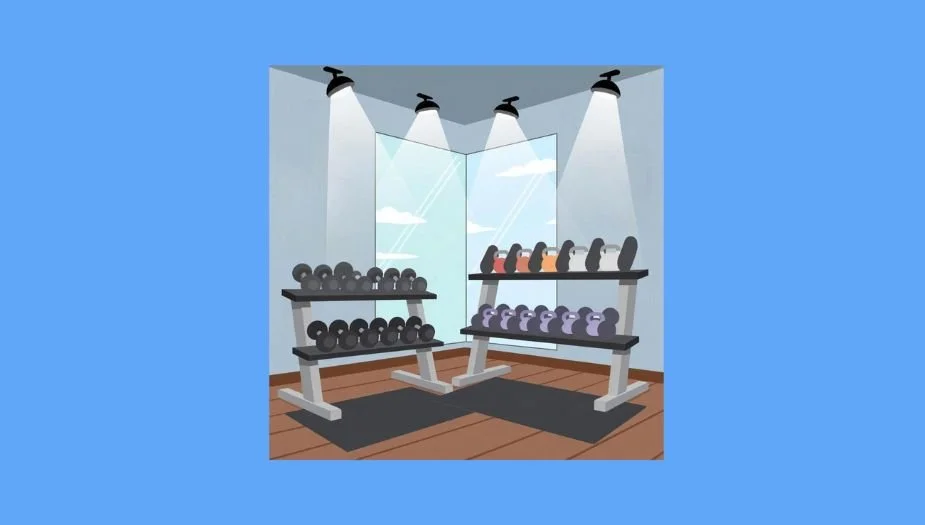
What We Mean When We Say "Free Weights"
Before we go further, let's be precise because this matters more than most people realize.
Free weights are not just barbells. The category includes dumbbells, kettlebells, barbells, and bodyweight movements — any form of resistance where you control the load through three-dimensional space without a machine dictating your path. A dumbbell Romanian deadlift is a free weight exercise. So is a kettlebell Turkish get-up, a weighted pull-up, or a barbell back squat.
Machines, by contrast, guide the movement for you. This includes traditional cable machines, plate-loaded isolation machines like the leg extension or chest fly, and the infamous Smith machine. The barbell-on-rails hybrid that lives in a category of its own.
The distinction matters because the debate isn't really about which piece of metal you pick up. It's about what your body is required to do while holding it.
The Case for Free Weights: Where the Science Holds Up
The fundamental argument for free weights that they engage more muscle, build more functional strength, and better prepare your body for real-world demands is well-supported by research. But let's get specific about what the evidence actually shows.
Stabilizer muscle activation is higher.
When you perform a free weight exercise like a barbell squat or dumbbell bench press, your body must recruit not just the primary mover — the quadriceps, the pectorals — but the full surrounding cast of stabilizer muscles and synergists that keep the movement controlled and the joint protected.
Research has observed higher recruitment of stabilizing muscles such as the rear and medial deltoid during free weight bench press compared to the Smith machine alternative. These are the muscles that protect your joints, support your posture, and determine whether you stay injury-free for decades.
Functional strength transfers better.
Strength built by free weight training transfers well to sports and real-world functional demands.
The same cannot be said for machine-based training, which tends not to transfer as fully in the other direction.
For high-achieving professionals who want to feel capable and strong in their bodies, not just look good in a gym, this transfer effect is significant.
Free weights allow natural movement patterns.
Your body doesn't move in a straight vertical line.
Your squat. Your press. Your hinge. All of these movements follow a path dictated by your individual anatomy, your hip structure, your shoulder mobility, your limb length.
Unlike the fixed path of a machine, free weights allow for a natural range of motion, supporting lifters to perform exercises that align with their personal biomechanics helping prevent joint strain and encouraging proper form.
Testosterone response is greater.
Training sessions with free weights induced greater increases in free testosterone in men compared to machine training, though both modalities resulted in similar increases in overall muscle mass and strength.
For the over-40 professional managing declining hormone levels alongside a high-stress lifestyle, this is not a trivial distinction.
Where the Research Pushes Back — And It Does Push Back
Here's where intellectual honesty matters more than tribal loyalty. Because the research throws a curveball that even experienced trainers sometimes resist acknowledging.
On muscle growth and strength: it's a draw.
This is the finding that surprises most people. A 2023 systematic review and meta-analysis found no differences in muscle hypertrophy when directly comparing free weight versus machine-based training.
Strength changes were found to be specific to the training modality: meaning you get better at the tool you train with.
In plain English: if you train with machines, you get stronger on machines. If you train with free weights, you get stronger on free weights. But the overall muscle you build? Largely the same.
A five-year research project published in Medicine & Science in Sports & Exercise assigned participants to free weight or machine programs and found that the overall changes in both muscle size and strength were indistinguishable between the two groups.
What does this mean for the free weights vs. machines debate? It means that for the singular goal of hypertrophy — building visible muscle — machines are not the inferior option that fitness culture makes them out to be. The muscle doesn't know or care whether the resistance is coming from a barbell or a cable stack. It responds to tension, progressive overload, and adequate recovery.
On injury risk: the free weight advantage is real but conditional.
This is the point that requires the most nuance. Research on weight-training injuries does suggest that the risk of acute injury is higher with free weights than with machines because free weights have no safety features or built-in support system. However, this finding comes with a critical asterisk: it applies primarily to untrained beginners and to situations where form has broken down under excessive load.
For the trained, technically proficient lifter, free weights are not inherently more dangerous. In fact, the argument can be reversed: a Smith machine forces your body into a fixed, unnatural bar path that doesn't account for individual biomechanics. One of the main criticisms of the Smith machine is that its restricted movement pattern can lead to muscle imbalances over time — and a body with chronic imbalances is a body trending toward injury.
The ability to bail safely out of a heavy free weight movement: to drop a dumbbell, step back from a barbell, or release a kettlebell, is a real advantage for experienced lifters. It requires training and awareness, but it makes the free weight environment safer, not more dangerous, for those who know what they're doing.
The Smith Machine: Love It or Hate It? It’s a Polarizing Topic.
Full disclosure: this section is the hardest one to write with intellectual honesty, because the Smith machine is genuinely easy to hate. The fixed bar path, the false sense of security, the way it turns a squat, one of the most elegant full-body movements in existence, into something that looks like a person riding an invisible escalator. The disdain is understandable.
But the research demands nuance. And nuance, in this case, is actually useful.
Let's start with the squat comparison, because it's the clearest lens for understanding what each tool actually does.
The barbell squat is superior for overall strength, athletic function, and stabilizer development. This isn't opinion, it's biomechanics. A free-weight barbell squat requires your quads, glutes, hamstrings, core, and spinal erectors to coordinate simultaneously while your stabilizer muscles work overtime to keep a loaded barbell balanced through a movement pattern that's entirely dictated by your own anatomy. That demand is the point. It builds the kind of integrated, transferable strength that carries over to sport, to real-world movement, and to long-term physical resilience in a way the Smith machine fundamentally cannot replicate.
Research has confirmed higher stabilizer muscle activation during free weight movements compared to Smith machine equivalents and those stabilizers are exactly what protect your joints, support your posture, and determine whether you're still training hard at 60 or managing a chronic injury.
But the Smith machine squat does something the barbell squat can't — and it's worth acknowledging. Because the bar path is fixed and the safety catches are built in, the Smith machine allows you to train closer to muscular failure with significantly less risk of a catastrophic bail. For quad isolation and hypertrophy work, that's a genuine advantage. You can push heavier, go deeper into fatigue, and focus neurologically on the target muscle rather than splitting attention between load management and balance. The fixed path also allows for specialized foot positioning that, when set up correctly, can emphasize the quads in ways that are difficult to replicate with a barbell.
The critical caveat: "set up correctly" is doing significant work in that sentence. The fixed bar path that makes the Smith machine feel safer can also force unnatural movement patterns on lifters whose anatomy doesn't align with the rail angle — potentially stressing the knees and lower back in ways that free weight movement, which self-corrects to your body's geometry, would not. The Smith machine doesn't adapt to you. You adapt to it.
For some people, that adaptation is fine. For others, it's a slow accumulation of joint stress they won't notice until they do.
Here's the honest summary: barbell squats win on strength, athletic transfer, and full-body engagement. The Smith machine wins on quad isolation and reducing the coordination demand when that demand is the limiting factor rather than the goal.
The Smith machine is best viewed as specialty equipment: useful in specific contexts, not a substitute for the foundational movement patterns that free weights develop. Use it for accessory work, targeted hypertrophy, or when injury or fatigue makes the stabilization demand of free weights counterproductive. Just don't let it become the headline act.
The Real-World Prescription: Who Should Be Doing What
Let's be direct: free weights should be the primary method of strength training for almost everyone, almost always. Not machines with a side of free weights. Free weights first, with machines earning their place in specific, well-justified contexts. That's the philosophy and the research supports it.
Here's how that plays out across different populations.
If you're new to strength training:
The instinct to put beginners on machines first is understandable, but it's might not be the best call. Machines don't teach your body how to move. They teach your body how to follow a track. And a beginner who builds their foundation on a track will eventually have to unlearn that dependency before they can develop real, transferable strength.
The smarter progression starts with bodyweight and scaled free weight movements that teach your nervous system to own the pattern before adding load. For lower body, that could mean: squat to box → bodyweight squats → DB goblet squats → barbell back squats, building positional awareness and hip hinge mechanics before a barbell ever touches your back.
For upper body pulling: this could look like resistance band-assisted pulldowns, supported band pull-ups, and TRX rows rather than relying on a lat pulldown machine. These progressions build the stabilizer engagement, the body awareness, and the movement integrity that machines simply cannot develop.
The Smith machine is not a beginner squat tool. It's a rail that teaches your body nothing about how to stabilize itself under load. The goal isn't to make beginners comfortable. It's to make them competent.
If you're a trained professional over 40 focused on longevity and performance:
Free weights are your foundation, non-negotiable. Build your program around compound movements: squats, deadlifts, presses, rows, and carries, scaled to your recovery capacity and stress load. These are the movements that keep you strong, functional, and structurally sound for the next several decades. Machines earn a supporting role for accessory work, targeted isolation, or injury management but they never become the headline act. The moment machines are running your program, your functional strength development has stalled.
If you're training for aesthetics and bodybuilding-style goals:
This is the one context where machines genuinely earn significant real estate in a program. Bodybuilding is a specialized discipline with its own set of rules, and hypertrophy-focused training legitimately benefits from the isolation capacity machines provide. Leg extensions, cable crossovers, machine flyes — these tools allow for targeted muscle loading and the ability to train to failure without the fatigue cost of full-body stabilization. For pure aesthetics goals, a higher machine volume is defensible and well-supported by the research. This is the exception, not the template.
If you're managing a physical limitation or recovering from injury:
Machines are not a compromise here. They may be exactly the right tool. The ability to control range of motion, isolate a movement, and reduce joint loading has genuine therapeutic value. Train intelligently within your current capacity, use machines to maintain strength and movement in the affected area, and reintroduce free weights progressively as your capacity returns. The goal is always to get back to free weight movement, but there's no shame in using the right bridge to get there.
The through-line across all of these: free weights are the destination. For some people, the path there includes a period of bodyweight progressions, banded assistance, and supported movements. For others, machines serve as a temporary bridge around a limitation. But the bridge is never the destination.
Using free weights to move your body through space, under load, with full stabilizer engagement and natural movement patterns builds lasting strength.
Final Thoughts
Free weights are the superior tool for building functional strength, developing stabilizer muscles, training movement patterns that transfer to real life, and for men, maximizing hormonal response to training. For high-achieving professionals who want to be genuinely strong, capable, and injury-resistant for the next several decades, free weights are the foundation.
But the claim that machines are categorically inferior is where the ideology outpaces the evidence. When it comes to building muscle, the research is clear: machines work. The muscle doesn't care about your equipment philosophy. It cares about load, tension, and recovery.
The smartest approach isn't choosing a side. It's using each tool for what it actually does well and building a program that serves your body, your goals, and your long-term health, not your gym identity.
Train with free weights because they make you stronger, more capable, and more resilient. Use machines strategically because some of them genuinely earn their place. And leave the equipment tribalism to people with more time than sense.
Article References
The sources cited in the article:
PubMed. "Acute Effect of HIIT on Testosterone and Cortisol Levels in Healthy Individuals." PubMed - Acute Effect of HIIT on Testosterone Cortisol
PubMed. “Cortisol Level and Psychological Functioning After 8-week HIIT Program During Pregnancy.” PubMed - HIIT and Pregnancy
PubMed. "The Effectiveness of a High-intensity Interval Exercise on Cardiometabolic Health and QOL in Older Adults.” PubMed - HIIT Older Adults
Healthline. "The Cortisol Creep: Is HIIT Stressing You Out?” Mayo Clinic - Chronic Stress Puts Your Health at Risk
National Geographic. “Cortisol Rises During Intense Workouts. Is That Really a Bad Thing?” NG - Cortisol Rises During Intense Workouts
PubMed. “Exercise and Circulating Cortisol Levels: The Intensity Threshold Effect” PubMed - Exercise and Circulating Cortisol Levels
NIFS. “High Intensity Interval Training (HIIT) and Seniors, Do they Mix?” NIFS - High Intensity Interval Training (HIIT) and Seniors, Do they Mix?
PubMed. “Pilot Study of a High-Intensity Interval Training Program in Older Adults” PubMed - HIIT Program in Older Adults