🗞️ The Wellness Briefing – Edition No.20: “Delegation Anxiety: When Letting Go Feels Unsafe” | November 11, 2025
3 minute read
Quick, high-impact wellness insights for ambitious professionals. Delivered Tuesdays.
Welcome Back to The Wellness Briefing
Burnout isn’t always from overwork. Sometimes, it’s from over-control. High performers often wear “I’ll just do it myself” like a badge of reliability — but what it really signals is fear. Fear that if you let go, something will break… or worse, you’ll look like you did.
This week, we’re unpacking the psychology of delegation anxiety — why you don’t trust others to handle it “right,” and how to lead without micromanaging yourself into exhaustion.
Let’s begin.
🧠 1 Insight Worth Reading: Harvard Business Review reported in 2024 that 39% of leaders admit they avoid delegating important work because they “don’t trust it will meet their standards,” even though teams led by effective delegators report 33% higher engagement and 20% faster project completion rates.
The paradox? The very control that protects your reputation often constrains your results. Delegation anxiety isn’t about competence — it’s about control as a coping mechanism for uncertainty and perfectionism. Read the full article at HBR.
💡 What That Means for You: When your nervous system equates “letting go” with “risk,” no amount of productivity tools will fix the bottleneck. The real work is shifting from “no one can do it like me” to “someone else can do it differently — and that’s okay.”
Delegation isn’t abdication; it’s redistribution. It creates space for strategy, rest, and growth. Because the goal isn’t doing more — it’s leading better.
✅ Next time you feel the urge to step in, run this quick check:
Is it high impact or just high visibility?
Is this task teaching me, or trapping me?
If I did nothing, what’s the real risk?
Then delegate one small thing you’d normally hoard. Start with discomfort, not disaster.
🎯 Pro Tip from the Guide: Micromanagement is anxiety with a to-do list. Replace “How can I control this?” with “How can I communicate this clearly?”
Leaders who focus on clarity over control delegate better, coach faster, and recover quicker.
🧩 Extra: The Psychology of Over-Control: Emerging research in cognitive neuroscience shows that chronic vigilance and over-monitoring—whether it’s people or projects—activate the brain’s stress response systems, particularly those tied to the amygdala and prefrontal cortex. In other words, constantly staying “on” keeps your body in a mild fight-or-flight state.
If you’ve ever wondered why even vacations feel tense, this is why: control is cognitively and physiologically draining. Over time, it leads to what researchers call cognitive fatigue—a state where focus, empathy, and decision-making start to erode.
🛠️ Tool / Resource Spotlight: Check out The Trust Equation by Charles Green — a simple framework (Credibility + Reliability + Intimacy ÷ Self-Orientation) that shows why over-control actually erodes trust. The lower your self-orientation — i.e., your need to manage perception — the higher your trustworthiness.
Use it to evaluate your own delegation style: Do you control to feel safe, or communicate to build trust?
📊 Wellness Stat of the Week: A 2025 Gallup Workplace report shows a significant link between effective delegation and reduced burnout for managers than those who retain too much ownership — and their teams report higher job satisfaction.
💬 Coaching Cue: “Delegation isn’t a loss of control — it’s a test of clarity. If you can’t hand it off, it’s not delegation you fear, it’s misalignment.”
📣 Gut Check: What’s hardest for you to delegate — work, decisions, or control?
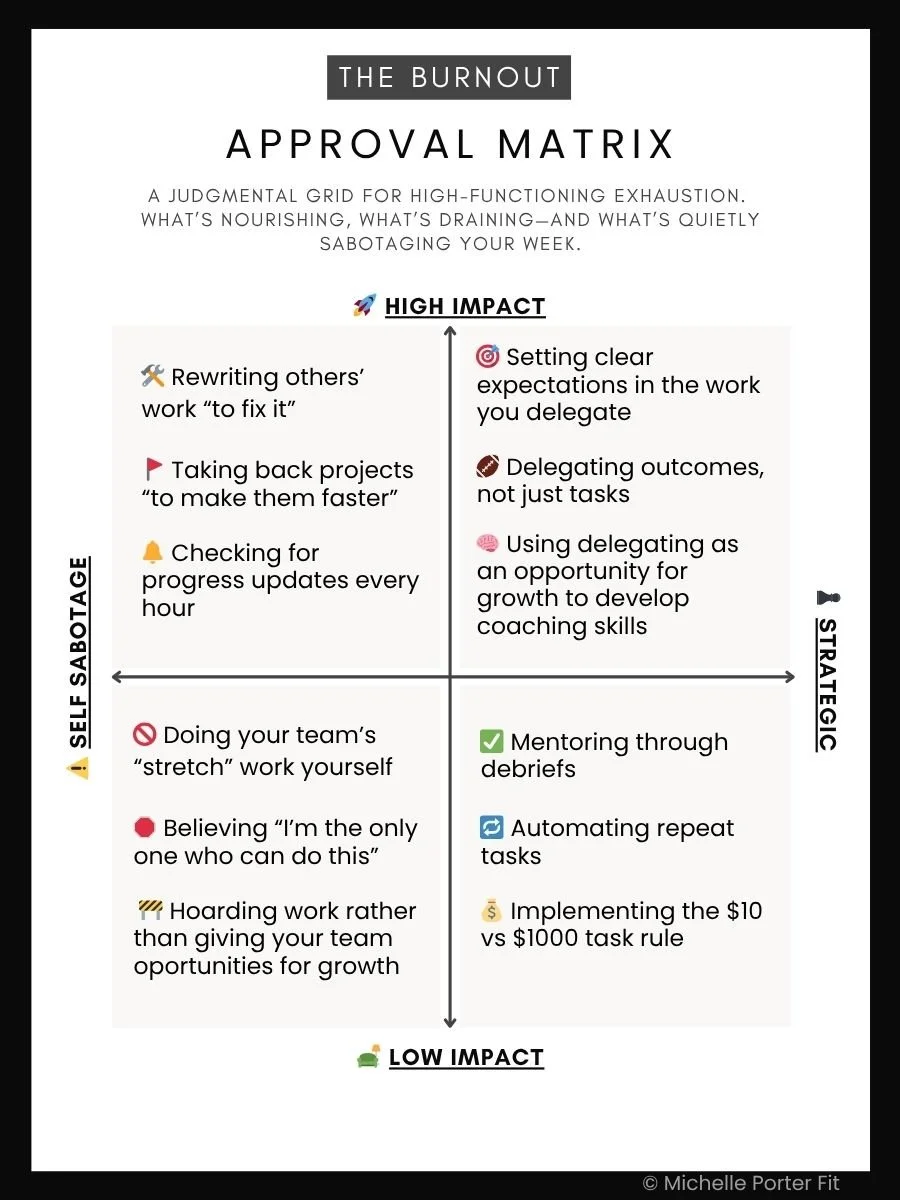
The Burnout Approval Matrix: Delegation Anxiety — A grid to highlight what amplifies clarity vs. what erodes it.
Want more support?
Book your free 20-min burnout consult here
Download your full Burnout Recovery Roadmap Guide
Get future issues delivered to your inbox Sign up here.
See you next Tuesday.
– Michelle