🗞️ The Wellness Briefing – Edition No. 25 “Holding On Until the Break: When Burnout Peaks Right Before Relief” | December 16, 2025
3 minute read
Quick, high-impact wellness insights for ambitious professionals. Delivered Tuesdays.
Welcome Back to The Wellness Briefing
If it feels like everything in your system is saying “I can’t do one more thing” — you’re not imagining it.
The stretch before a break is often harder than the break itself. Deadlines compress. Expectations spike. Capacity is already depleted. And the finish line keeps moving just far enough away to stay stressful.
This isn’t weakness. It’s what happens when a tired nervous system is asked to perform endurance under pressure.
This week’s briefing is about stabilization — not transformation — while you make it to the pause.
Let’s begin.
🧠 1 Insight Worth Reading: Stress research shows that the brain responds poorly to delayed relief. When rest is promised but not yet accessible, the nervous system stays in a heightened state — conserving energy while remaining vigilant.
In practical terms:
Focus drops faster
Emotions spike more easily
Small issues feel disproportionately heavy
You’re not failing at resilience. You’re operating on fumes while still being asked to deliver.
💡 What That Means for You: Right now, your job isn’t to optimize performance.
It’s to reduce damage.
This is not the week to:
Start new initiatives
Have high-stakes emotional conversations
Push through “just one more thing” repeatedly
Burnout accelerates when depleted people mistake endurance for discipline.
The most strategic move is containment.
✅ Try This: Use the Minimum Viable Week approach:
Ask yourself:
What actually must get done before the break?
What can wait without real consequence?
Where am I adding pressure out of habit, not necessity?
Then deliberately under-scope the rest.
Survival weeks are not a moral failure. They’re a professional skill.
🎯 Pro Tip from the Guide:
When capacity is low, decisions cost more than actions.
If you’re exhausted:
Reduce choices
Reuse defaults
Say “I’ll revisit this in January” without apology
Clarity now protects recovery later.
🧩 Extra: Why This Moment Feels So Precarious:
Late-stage burnout often shows up as:
Emotional fragility
Irritability over minor things
Difficulty thinking past the next task
That’s not collapse — it’s a system signaling it cannot absorb more.
Listen before it forces the issue
📊 Wellness Stat of the Week: Burnout studies consistently show that the highest risk period isn’t during sustained overload — it’s immediately before expected relief, when people overextend to “get there.”
Translation: the final push is where most damage happens.
🔧 Tool / Resource Spotlight: The 3–3–3 Stabilizer
Each day until the break:
Do 3 essential tasks
Cancel or defer 3 non-essential asks
Build in 3 true pauses (5–10 minutes, no input)
This isn’t productivity. It’s load management.
📣 Pulse Check:
What are you most eager to put down when the break starts:
Decisions, responsibility, or emotional labor?
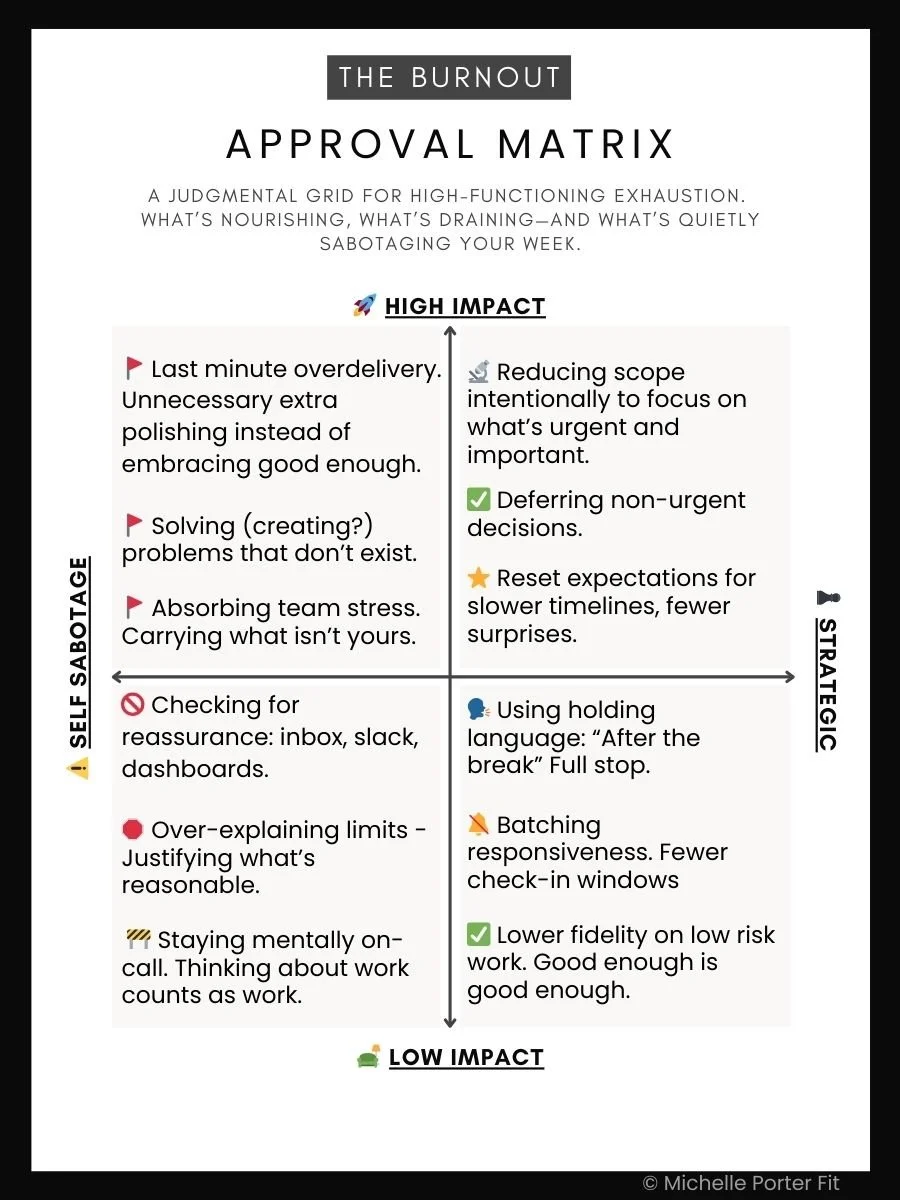
📈 The Burnout Approval Matrix: Trust Fatigue — A grid to highlight what are strategic risks vs. what might be self-sabotage.
Want more support?
Book your free 20-min burnout consult here
Download your full Burnout Recovery Roadmap Guide
Get future issues delivered to your inbox Sign up here.
See you next Tuesday.
– Michelle