🗞️ The Wellness Briefing – Edition No. 24 “Cognitive Overload: Why Your Brain Feels Like It Has 47 Tabs Open” | December 9, 2025
3 minute read
Quick, high-impact wellness insights for ambitious professionals. Delivered Tuesdays.
Welcome Back to The Wellness Briefing
Burnout isn’t always emotional. Often, it’s operational.
Modern work is engineered for cognitive overwhelm: rapid context switching, Slack pings masquerading as urgency, calendars that resemble Tetris, and the invisible labor of remembering everything no one else tracks. The result? Your brain feels like it has 47 tabs open, all auto-refreshing.
This week, we’re unpacking cognitive overload — why decision fatigue and constant interruptions make it hard to “hear yourself think,” and how to reclaim mental bandwidth with practical micro-boundaries.
Let’s begin.
🧠 1 Insight Worth Reading: Neuroscience has been clear for years: the prefrontal cortex — your center for decision-making, planning, and focus — has a finite capacity. And modern work burns through it faster than anything else.
A few data points worth noting:
Research from the University of California, Irvine shows that it takes over 23 minutes to recover full focus after an interruption.
Harvard Business Review estimates that employees switch windows or tasks 1,200 times per day on average.
Harvard researchers have shown that decision fatigue reduces accuracy and self-regulation — even in highly trained professionals like judges and physicians.
Cognitive overload isn't a mindset problem; it’s a bandwidth problem.
💡 What That Means for You: When your brain is overloaded, everything feels harder:
Decisions take longer.
Creativity disappears.
Emotional tolerance drops.
Small tasks feel disproportionately draining.
Cognitive overload makes your world feel louder — even when nothing has changed externally. You’re not “being dramatic.” Your brain is maxed out.
The fix isn’t “trying harder” or “being more disciplined.” It’s reducing the constant cognitive drag that’s eating your capacity.
✅ Try This: Here are three micro-boundaries that restore cognitive bandwidth almost immediately:
1. Set a “No-Decision Window.”
Choose a 1–2 hour block daily where no decisions are made. You execute only what’s already defined. No new requests. No planning. No switching.
2. Interrupt the interruptions.
Before responding to a Slack or email ping, ask: “Does this need my brain or just my acknowledgment?” Half of interruptions can be deferred, delegated, or dismissed.
3. Use a “Single-Tab Rule” for complex work.
Close everything that’s not related to the task at hand. When you stop feeding the tabs, they stop feeding the stress.
🎯 Pro Tip from the Guide: Your brain can’t distinguish between a task you’re actively doing and one you’re mentally holding. Unwritten to-dos drain the same cognitive energy as active work.
That’s why externalizing tasks — lists, notes, project boards — is a cognitive performance strategy, not an organizational quirk.
Get things out of your head. Your brain is a processor, not a storage unit.
🧩 Extra: The Hidden Cost of Invisible Labor: Invisible labor — remembering deadlines, tracking follow-ups, spotting errors, preparing others for success — is one of the largest drivers of cognitive burnout in high performers.
It’s unpaid, unrecognized, and mentally expensive.
The more responsibilities you “just keep in your head,” the more you tax your executive function. This is why even small requests can feel like the final straw: they’re landing on top of everything no one sees.
Your brain was never designed to be your team’s project manager.
📊 Wellness Stat of the Week: The American Psychological Association reports that nearly 60% of workers experience daily cognitive fatigue linked to constant interruptions and digital overload — with multitasking reducing performance by up to 40%.
💬 Coaching Cue: “You’re not overwhelmed because you’re weak. You’re overwhelmed because your brain is running a marathon made entirely of micro-decisions.”
Capacity is created, not inherited.
📣 Pulse Check:
What’s your biggest source of cognitive overload right now — interruptions, decision fatigue, or invisible labor?
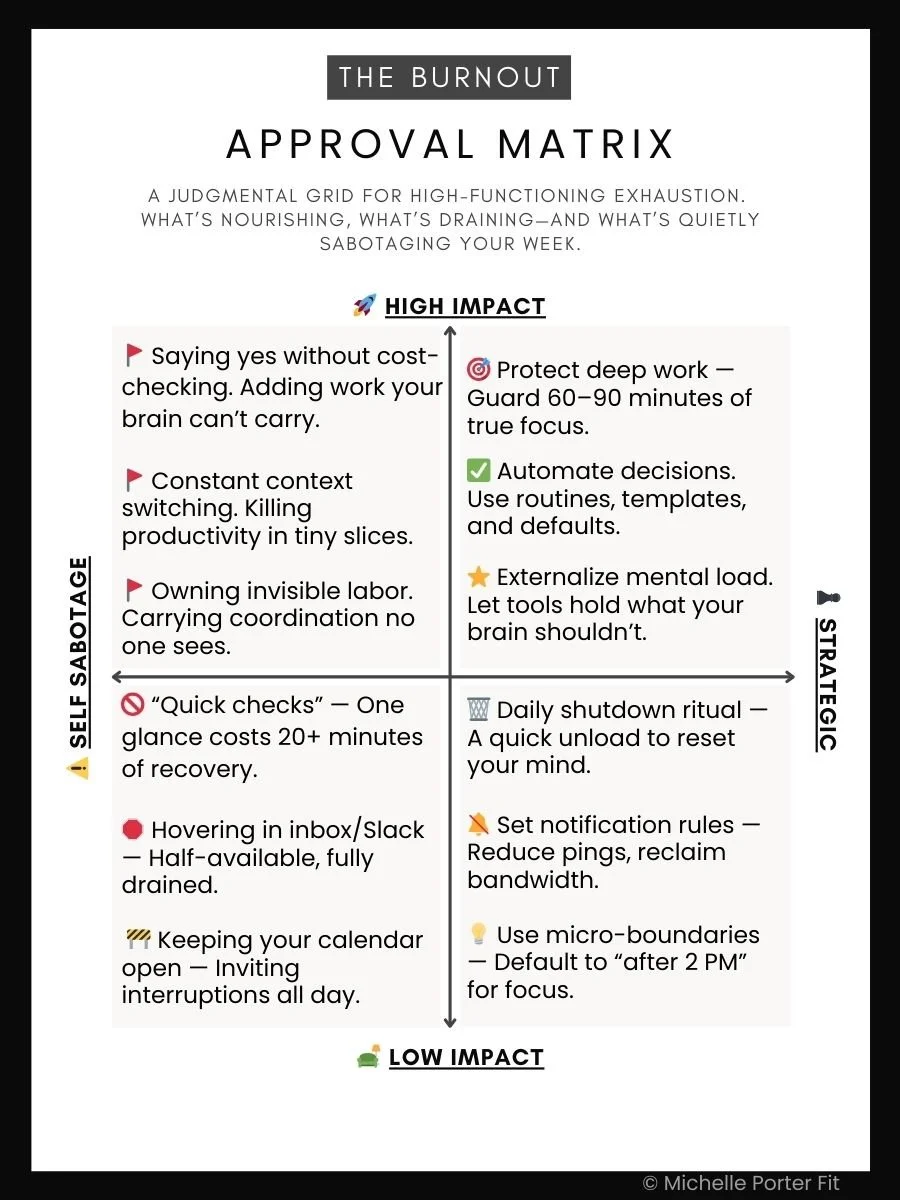
📈 The Burnout Approval Matrix: Trust Fatigue — A grid to highlight what are strategic risks vs. what might be self-sabotage.
Want more support?
Book your free 20-min burnout consult here
Download your full Burnout Recovery Roadmap Guide
Get future issues delivered to your inbox Sign up here.
See you next Tuesday.
– Michelle