🗞️ The Wellness Briefing – Edition No. 23 “Trust Fatigue: When Leadership Turns Into Hypervigilance” | December 2, 2025
3 minute read
Quick, high-impact wellness insights for ambitious professionals. Delivered Tuesdays.
Welcome Back to The Wellness Briefing
High performers treat risk the same way they treat rest: they wait for the perfect moment that never arrives. But the truth is this — your life and career expand when you take smart, controlled risks, not when you cling to certainty as a coping mechanism.
This week, we’re breaking down how to make decisions that stretch your growth — without stretching your nervous system to snapping point.
Let’s get into it.
🧠 1 Insight Worth Reading: A 2025 Deloitte Well-Being Survey found that 77% of employees have experienced burnout feeling “constantly on alert”, even during downtime. The report links this pattern to anticipatory stress — essentially, your brain rehearsing catastrophes to feel prepared.
The real problem with being “constantly on alert”:
Leaders with high in anticipatory stress tend to have lower recovery quality, even when they sleep 7+ hours. Hypervigilance drains you even when nothing is wrong.
Trust fatigue isn’t about others. It’s about your nervous system expecting threat where there is none.
💡 What That Means for You: If you feel like you can’t relax unless you’re checking in, checking up, or checking everything, you’re not experiencing “high standards.” You’re experiencing a dysregulated stress cycle.
When your baseline state is bracing for impact:
Small emails feel urgent
Neutral feedback feels threatening
Minor mistakes feel like personal exposure
Rest feels unsafe
Leadership becomes surveillance — and recovery becomes impossible.
Trust fatigue is not a mindset issue. It’s a physiological bottleneck that constricts your creativity, strategic thinking, and capacity to connect.
✅ Try This: Use this quick pattern disruptor during moments of “I should check on it”: The 20/80 Scan
Ask yourself:
Is 20% of this urge about real risk…
(a deadline, a dependency, a decision?)…or is 80% about my nervous system trying to preempt discomfort? (fear of judgment, visibility, uncertainty?)
If it’s mostly emotional risk — pause. Let the discomfort rise and fall for 30 seconds before acting. You’ll train your brain to respond, not react.
🎯 Pro Tip from the Guide: Hypervigilance is the nervous system’s attempt at quality control.
But leaders who excel sustainably do this instead:
“Shift from monitoring to meaning-making.”
Don’t ask: What might go wrong?
Ask: What would build capability? Psychological safety? Alignment?
Leadership grows when surveillance decreases.
🧩 Extra: The Neuroscience of Hypervigilant Leadership: A 2022 study found that chronic monitoring engages the amygdala’s threat-response circuits more intensely than high-pressure decision-making itself.
Translation: Being in control is less stressful than watching for potential loss of control.
This is why:
You crash after big presentations
You feel tired after “easy but visible” tasks
You dread weekends with no structure
You can’t mentally shut down during PTO
Your brain is wired to detect danger — even in inbox notifications.
Trust fatigue isn’t a personality flaw. It’s a nervous system habit.
🛠️ Tool / Resource Spotlight: Explore The Neuroception Framework by Dr. Stephen Porges — a model explaining how your body perceives safety or threat before your mind has time to think.
Key takeaway for leaders:
You can’t logic your way out of hypervigilance.
You must signal safety to your body — through breath, boundaries, and capacity-building.
📊 Wellness Stat of the Week: Deloitte 2025 Workplace Well-Being Survey found 74% of employees report workload and leadership pressures as the biggest obstacles to their well-being, and only 52% consistently practice restorative habits (micro-breaks, sleep, movement).
Turns out letting go is measurable — and impactful.
💬 Coaching Cue: “Trust isn’t the opposite of control — safety is. Build safety in your body, and your leadership will follow.”
📣 Pulse Check:
Where does hypervigilance show up most for you: email, meetings, performance, or downtime?
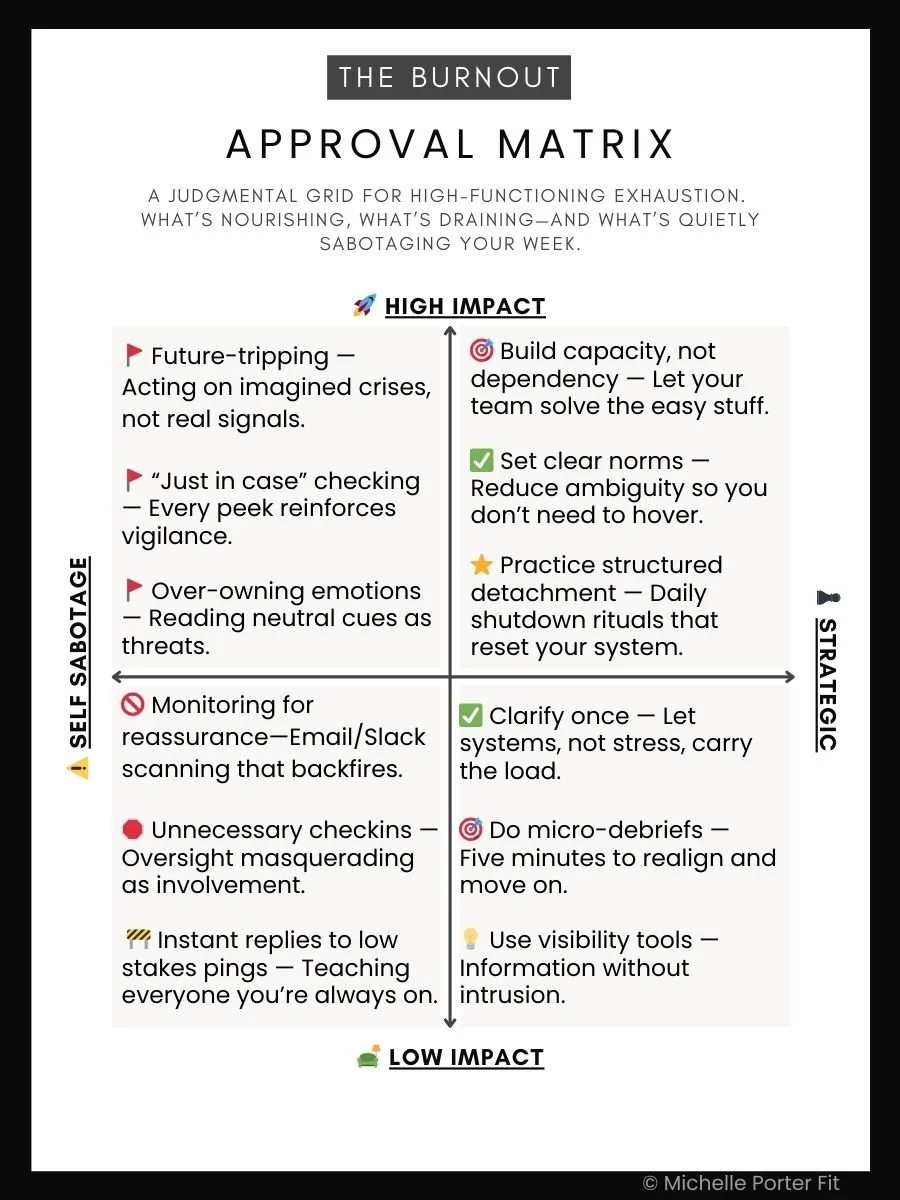
📈 The Burnout Approval Matrix: Trust Fatigue — A grid to highlight what are strategic risks vs. what might be self-sabotage.
Want more support?
Book your free 20-min burnout consult here
Download your full Burnout Recovery Roadmap Guide
Get future issues delivered to your inbox Sign up here.
See you next Tuesday.
– Michelle