Hydration Check: You're Probably Dehydrated and Just Don't Know It Yet
Your water intake is one of the highest-leverage health behaviors you can fix starting today.
Here's a question worth sitting with: when did you last drink a full glass of water? Not coffee. Not a sparkling water you sipped halfway through a meeting. A full, deliberate glass of plain water.
If you're pausing to think about it, you're probably not as hydrated as you think you are.
Most high performers are walking around in a state of mild chronic dehydration that they've normalized as just how they feel. The afternoon brain fog, the 3pm headache, the heavy-legged fatigue that settles in by mid-morning, the focus that never quite sharpens the way it should. They attribute it to stress, poor sleep, too much on their plate. Sometimes that's accurate. Often it's water. Or rather, the absence of enough of it.
Your body is approximately 60% water. Your brain is 75% water. Every cognitive function, every hormonal signal, every cellular process, every workout recovery, every digestive function runs on adequate hydration. When you're even mildly dehydrated, everything gets harder — physically, mentally, and metabolically. And the threshold for "mild dehydration" is lower than most people realize.
Hydration might be one of the most unsexy topics in wellness and also the most consistently neglected one.
The good news: it's also one of the highest-leverage things you can fix starting today. for your energy, your focus, your performance, and your waistline.
Let's fix this. Starting with why you're probably already behind before your day has even started.

Why You Wake Up Dehydrated Every Single Morning
You haven't had a drink in eight hours. You've been sleeping and breathing — which expels water vapor with every exhale. If you're in a heated or air-conditioned bedroom, you're losing even more fluid through the dry air. If you sweat at night, more still. By the time your alarm goes off, you've lost somewhere between one and two pounds of fluid through respiration and passive evaporation alone, without doing anything.
That is mild dehydration. Every morning. Before you've made a single decision about your day.
Now add the choices from the night before. A salty dinner or late-night snack pulls additional water into your digestive system to process sodium, increasing overnight fluid loss. A few glasses of wine or a cocktail before bed — alcohol is a significant diuretic that actively suppresses the hormone that tells your kidneys to retain water, meaning you lose more fluid than you take in.
And then the morning ritual begins. The first thing most high performers reach for is coffee. Which leads to an important clarification.
Not All Fluids Are Created Equal
Here's a question that cuts through a lot of confusion:
If you drink one cup of water and one cup of coffee, in which scenario will you need the bathroom faster?
The coffee. Every time. And that tells you something important about what these two beverages are doing differently inside your body.
Coffee and tea do count toward your daily fluid intake — the research is clear on this. A well-designed study found that moderate coffee consumption in caffeine-habituated drinkers provided similar hydrating qualities to an equivalent volume of water across multiple hydration markers. Caffeinated beverages are not dehydrating at moderate doses. They are, however, less hydrating than plain water because caffeine has a mild diuretic effect that increases urine output. For every cup of coffee, you get the hydration benefit of the water it contains — minus the extra fluid your kidneys excrete in response to the caffeine.
The practical implication: coffee counts, but it doesn't count the same. One cup of coffee is roughly equivalent to three-quarters of a cup of water in hydrating value. Two cups of coffee in the morning is not a substitute for two cups of water. It is a reasonable start that still leaves a gap you need to close with plain water throughout the day.
The hierarchy of hydrating fluids, from most to least effective:
Plain water at the top.
Herbal teas — no caffeine, full hydrating value.
Milk — genuinely hydrating, well-supported by research, good electrolyte content.
Caffeinated tea — slightly below water.
Coffee — meaningful but net positive only in moderation.
Sparkling water — equivalent to flat water, carbonation doesn't diminish hydration.
Juice and sports drinks — hydrating but carry significant sugar loads.
Alcohol — net negative. Not just a diuretic but an antidiuretic hormone suppressor that causes your body to excrete more fluid than you consume.
The bottom line: water is your primary hydration tool. Everything else is a supporting player.
What Dehydration Is Actually Doing to Your Performance
This is where the stakes become real for the high performer specifically.
Being dehydrated by just 2% of body weight impairs performance in tasks that require attention, psychomotor skills, and immediate memory. That's not extreme dehydration — that's two pounds of fluid loss in a 160-pound person. That's waking up in the morning without having rehydrated adequately. That's a normal Tuesday for most busy professionals.
The brains of dehydrated adults show signs of increased neuronal activation when performing cognitively engaging tasks, indicating that their brains are working harder than normal to complete the same task. Your brain doesn't fail when you're mildly dehydrated. It compensates, but compensation has a cost. It shows up as fatigue, mental friction, slower decision-making, and the sense that thinking takes more effort than it should.
Beyond cognition, dehydration strains your cardiovascular system. When fluid volume drops, your heart has to work harder to circulate blood — heart rate elevates, blood pressure rises, and the heaviness and fatigue in your legs that make sitting through a long afternoon of meetings feel genuinely uncomfortable is often partly a circulation problem driven by inadequate hydration. For someone already carrying a high stress load with elevated cortisol and a nervous system running hot, adding dehydration to that picture is like throwing sand in the engine.
Rehydration after water supplementation alleviates fatigue and improves mood, short-term memory, attention, and reaction time. The fix isn't complicated. But it requires consistency.
How Much Water Do You Actually Need?
The old "eight glasses a day" guideline is a reasonable starting point but not especially precise. Here's a more useful framework.
The current U.S. National Academies guidelines recommend approximately 15.5 cups (3.7 liters) of total daily fluid for men and 11.5 cups (2.7 liters) for women — from all sources including food, which accounts for roughly 20% of daily water intake. That means the actual beverage target is closer to 12 cups (3 liters) for men and 9 cups (2.2 liters) for women as a baseline.
Translated into practical bottle math:
In 16-ounce bottles — the standard size most people carry:
Men need: 7 to 8 bottles per day
Women need: 5 to 6 bottles per day
In 32-ounce bottles:
Both men and women need 3 to 4 refills per day.
One 32-ounce bottle equals four cups, equals approximately one liter.
Three of them gets you to 96 ounces.
Four gets you to 128 ounces — the gallon benchmark that represents an excellent hydration goal for most active adults.
A one-gallon jug:
If that's your style, covers both men and women comfortably when consumed across the full day.
One important principle that applies regardless of which format you use: sip consistently across the day rather than consuming large amounts at once.
Your kidneys can only process approximately one liter of fluid per hour. Drinking 32 ounces in ten minutes doesn't produce better hydration than drinking it across two hours — and large, rapid fluid intake can actually dilute electrolyte levels. The goal is steady, distributed intake that keeps your hydration status consistently topped up rather than cycling between deficit and flood.
For active individuals, those training in heat, or anyone carrying significant stress loads that produce elevated cortisol — which increases fluid excretion — baseline targets should be adjusted upward. A simple and more personalized target: one ounce of water per pound of bodyweight daily. A 160-pound person targets 160 ounces — five 32-ounce refills, or exactly one gallon plus a bit.
The Urine Color Chart: Your Built-In Hydration Monitor
Your body gives you real-time feedback on your hydration status every time you use the bathroom. Most people just aren't paying attention.
Urine color is one of the most reliable and accessible indicators of hydration status available — no blood draw, no wearable, no app required. The color reflects the concentration of waste products your kidneys are filtering: the more diluted your urine, the lighter the color and the better hydrated you are. The more concentrated, the darker — and the more urgently your body needs fluid.
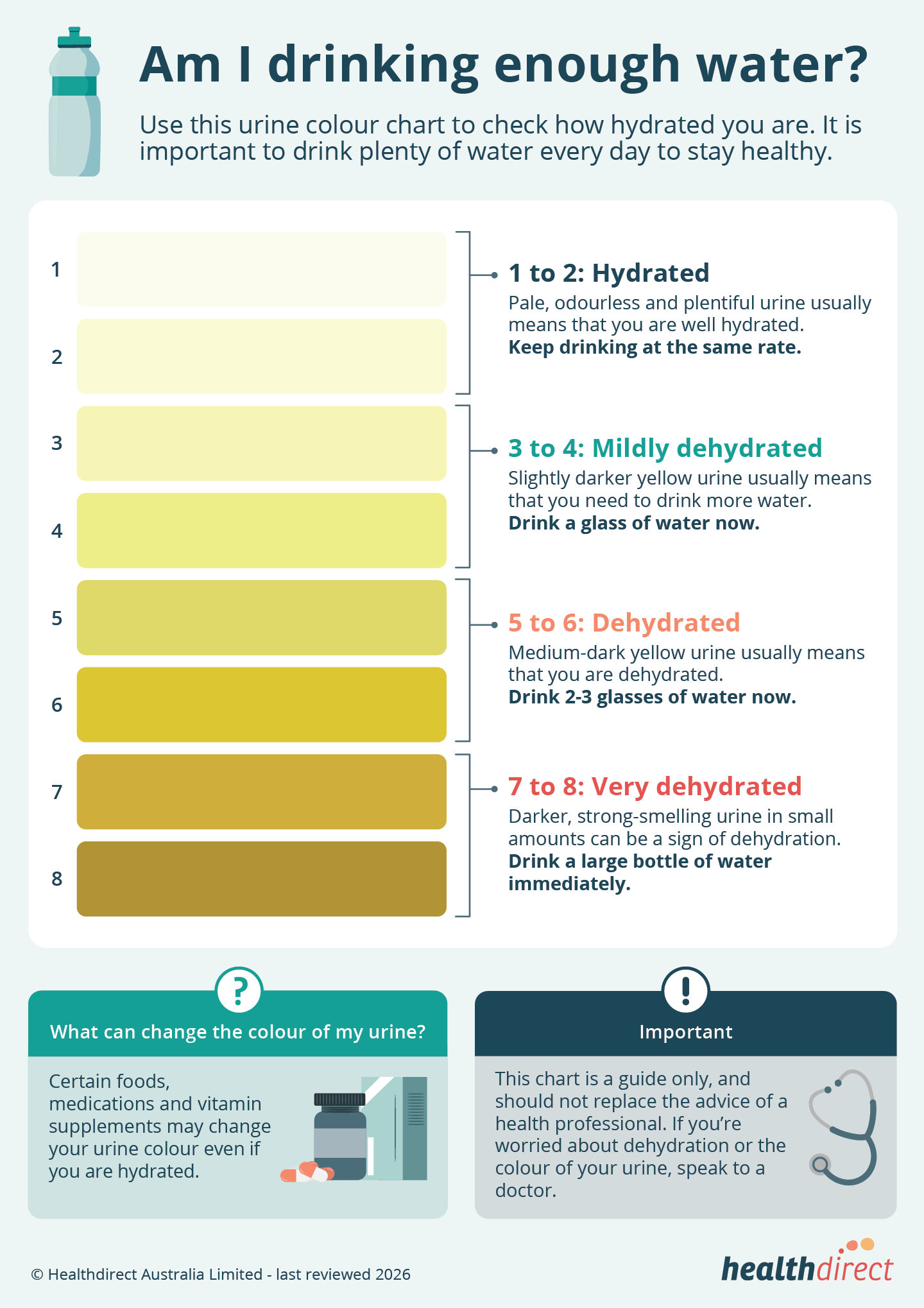
South Tees Hospitals NHS Foundation Trust (Urine Color Chart)
Hydration color chart notes:
Pale straw to light yellow — this is your target.
You are well hydrated.
Your kidneys are processing waste efficiently and your fluid intake is keeping pace with your body's demands.
Medium yellow — you're on the edge.
Not critically dehydrated, but your body is beginning to concentrate urine, which means fluid intake isn't keeping up with output. Drink soon — within the next thirty minutes.
Dark yellow — you are dehydrated.
Your kidneys are conserving water by concentrating waste products significantly.
This is the range where cognitive performance, energy, and cardiovascular efficiency are measurably impacted. Drink water now, not at your next scheduled break.
Amber or brown — you are significantly dehydrated.
This requires immediate fluid intake and sustained attention to hydration for the next several hours.
If amber urine is accompanied by dizziness, confusion, rapid heart rate, or muscle cramps, seek medical attention.
One practical note on how to check: checking urine color in the toilet bowl is less accurate than checking it in a cup or against a white background because toilet water dilutes and shifts the color. If you want an accurate read — particularly first thing in the morning when hydration status is most likely to be compromised — the cup method gives a truer color.
Check your color first thing in the morning before your coffee, and again at midday. These two check-ins tell you what your overnight hydration deficit looks like and whether your morning intake has been adequate to restore it. Most people find that their morning urine is consistently darker than they expected — which is the baseline deficit we discussed at the start of this article, made visible.
Practical Systems That Actually Work
Knowing you need more water and consistently drinking more water are two different problems. The first is an information problem. The second is a systems problem. Here's how to solve the systems problem.
1. Choose your vessel and commit to it. The single most effective hydration behavior change available is selecting a water bottle of a known size and making it your constant companion.
A 32-ounce bottle that you refill three to four times per day is a complete hydration system — no tracking app, no complicated math, no willpower required beyond keeping it full and within reach. The physical presence of the bottle is a passive cue to drink. The visible water level is a passive progress tracker. The act of refilling it creates natural hydration checkpoints throughout the day.
A 64-ounce bottle — the half-gallon format increasingly popular among high performers — covers most people's daily needs in two fills.
A one-gallon jug, if you're the type who likes to see the whole target in one container and watch it empty, is a perfectly valid approach that many people find motivating.
2. Front-load your morning. Before the coffee, before the email, before anything — drink sixteen ounces of water.
This is the single highest-leverage hydration habit available because it directly addresses the overnight deficit you wake up with every morning. It takes ninety seconds. It rehydrates your brain before you ask it to perform. It creates a positive hydration momentum that makes the rest of the day's intake easier to sustain.
Put a large glass or full water bottle on your nightstand the night before so the barrier to doing this is zero.
3. Time your intake around your schedule, not against it. One of the most common reasons busy professionals under-hydrate isn't forgetting — it's meeting schedules, long blocks without bathroom access, and the practical reality of not wanting to raise your hand to leave a client presentation.
The solution isn't to drink less. It's to drink strategically.
Hydrate aggressively before work and before long meetings. Sip lightly and steadily during the work block. Hydrate again actively after your schedule clears.
This rhythm — front-load, maintain, restore — works with your professional constraints rather than fighting them.
4. Know your bathroom geography. This sounds almost absurdly practical, but it matters: know where the reliable restrooms are in your regular locations — your office building, your client sites, your regular meeting venues.
When you've identified them, the low-level anxiety that makes people unconsciously self-limit their water intake dissolves. You're not making a high-stakes gamble every time you refill your bottle. You have a plan.
5. Pair hydration with existing habits. Sip cues are one of the most underrated behavior change tools available.
Every time you sit down at your desk — drink.
Every time a meeting ends — drink.
Every time you check your phone — take three sips.
Every time you eat — drink before the meal.
These micro-habit attachments require no additional willpower because they piggyback on behaviors that are already automatic. Over time they become equally automatic, and your hydration happens without conscious effort.
6. Eat your water. Approximately 20% of daily water intake comes from food.
Fruits and vegetables with high water content — watermelon (92% water), cucumber (97%), strawberries (91%), oranges (86%), celery (95%) — meaningfully contribute to your daily totals.
This isn't a substitute for drinking water, but it's a legitimate and often overlooked supplement to it, particularly useful on days when your drinking schedule gets compressed.
The Caffeine Conversation
Most high performers are managing their energy with caffeine rather than with hydration — and paying a performance tax for the substitution.
The pattern is familiar: start the day behind on sleep, reach for coffee to compensate, drink two or three cups before noon, hit a mid-afternoon slump, reach for another coffee or an energy drink. Repeat.
The problem isn't the caffeine per se. It's that caffeine is being used to paper over the fatigue and cognitive dullness that is, at least partly, a hydration problem. Caffeine addresses the symptom. Water addresses the cause.
A practical experiment: for one week, before reaching for the afternoon coffee or energy drink, drink sixteen ounces of water first and wait fifteen minutes. For a meaningful portion of people, the fatigue and fog that prompted the caffeine reach either resolves or significantly diminishes. The body wanted water. The brain interpreted the signal as needing stimulant.
This isn't about eliminating coffee. Coffee is a legitimate performance tool with real cognitive benefits at appropriate doses. It's about ensuring that caffeine is doing its job on top of adequate hydration rather than doing the job that adequate hydration should have done first.
The Financial Footnote
This one is straightforward and worth naming: consistently hitting your daily water intake from a reusable bottle costs essentially nothing. The same daily fluid intake purchased as bottled water, sports drinks, energy drinks, or convenience store beverages costs approximately ten to fifteen dollars per week — five hundred to seven hundred and fifty dollars per year.
Hydration is one of the highest-ROI health behaviors available. The infrastructure investment is a quality reusable bottle. The ongoing cost is tap water. The return is measurably better cognitive performance, energy, and physical function.
It's genuinely one of the best deals in wellness.
Final Thoughts
The goal of all of this is not to have you thinking about water constantly, tracking ounces obsessively, or reorganizing your schedule around bathroom logistics. The goal is to build a rhythm — a default pattern of hydration behavior that happens consistently without conscious effort and fits the actual structure of your day.
For most high performers, that rhythm looks something like this: sixteen ounces before anything else in the morning. A full 32-ounce bottle at your desk or in your bag that gets refilled twice before noon and once in the afternoon. A glass of water with every meal. A sip every time you sit down, pick up your phone, or transition between tasks.
That's it. That's a well-hydrated day. Not glamorous. Not complex. Not requiring any willpower beyond the initial setup.
What it produces — consistently, reliably, within days of doing it — is a cognitive clarity, a physical energy, and a baseline sense of wellbeing that most chronically under-hydrated people have forgotten is available to them.
Your brain is 75% water. It performs best when that percentage is maintained. Start there.
Article References
The sources cited in the article:
PubMed. “Cognitive Performance and Dehydration.” PubMed - Cognitive Performance and Dehydration
PubMed. “Effects of Dehydration and Rehydration on Cognitive Performance and Mood.” PubMed - Dehydration and Rehydration
Cognitive Vitality (CV). “Can Dehydration Impair Cognitive Function?” CV - Dehydration Impair Cognitive Function