Taking Things Personally is One of the Fastest Ways to Stress Yourself into the Ground (And What to Do About It)
The moment you realize it was never about you, everything shifts.
One of the fastest ways to drain your energy, erode your confidence, and quietly push yourself toward burnout is taking other people’s behavior personally. Not in the obvious, thin-skinned sense—but in the subtle, professionalized way high performers do it every day.
A client pushes back on scope and you assume dissatisfaction. A colleague challenges your thinking and your body reacts before your mind catches up. A leader goes quiet and you replay the last three weeks of interactions, searching for the misstep. You don’t just observe what’s happening. You internalize it.
Over time, this habit becomes exhausting. Not because the situations are catastrophic, but because your nervous system treats them as if they are. When you consistently interpret other people’s reactions as information about your worth, competence, or standing, you don’t become more effective. You become more depleted.
The uncomfortable truth most high achievers eventually have to face is this: most people are not reacting to you. They’re reacting for themselves. Their incentives, their pressure, their fears, their blind spots. You happen to be nearby.
The Stress Cycle: How Taking It Personally Fuels Burnout
Most people aren’t thinking about you as much as you think they are. They’re thinking about their own pressures, their own deadlines, their own needs. You? You’re just part of their bigger picture.
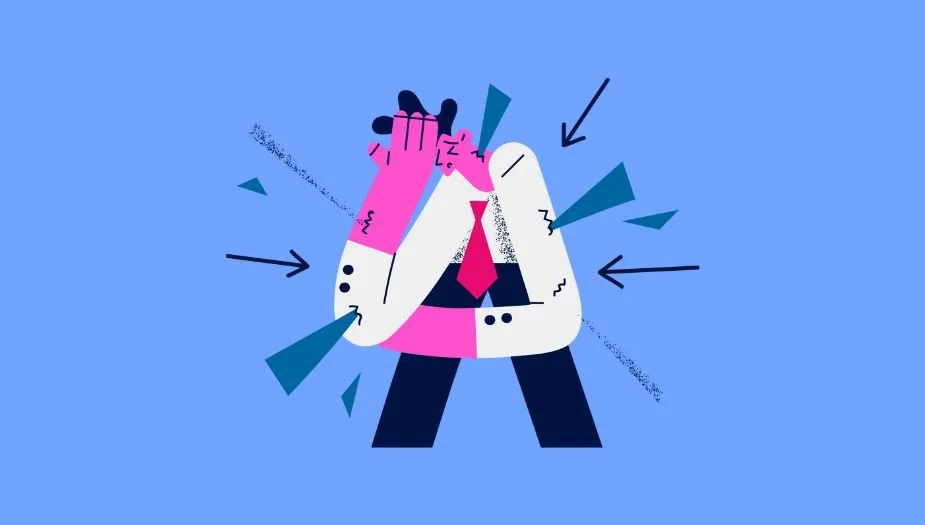
But when you interpret every challenge as a personal slight, you activate your stress response. Your brain shifts into fight-or-flight mode, cortisol floods your system, and suddenly you’re expending mental energy on defensiveness instead of strategy.
Over time, this chronic stress builds. You feel emotionally drained, physically exhausted, and mentally overwhelmed—not because of the actual demands of your work, but because of how you’re perceiving and reacting to them.
Why High Performers Take Things Personally
If you’re driven, conscientious, and invested in doing good work, you’ve likely been rewarded for being highly attuned to feedback. You read the room. You anticipate needs. You notice subtle shifts in tone, timing, and body language that others miss. These traits are often praised early in high-performing careers.
Under sustained pressure, however, that same sensitivity can turn inward.
Many high achievers were conditioned—long before their careers—to monitor others closely. They learned to adapt quickly to expectations, take responsibility for outcomes that weren’t fully theirs, and equate approval with safety or success. In professional environments that prize responsiveness and accountability, this wiring is reinforced.
Performance reviews, client satisfaction metrics, stakeholder alignment—your nervous system learns that other people’s reactions matter. So when something feels off, your brain fills in the gap almost instantly: I must have done something wrong.
That reflex isn’t a flaw. It’s a learned strategy. But what once helped you succeed can quietly become the mechanism that keeps you chronically stressed.
How Personalization Triggers the Stress Response
When you interpret neutral or ambiguous situations as personal threats, your body responds accordingly. The nervous system does not distinguish between a career-ending crisis and a vaguely tense email. It responds to perceived threat, not objective danger.
Physiologically, this looks like elevated cortisol, muscle tension, narrowed attention, and shallow breathing. Cognitively, it shows up as rumination, defensiveness, and an urgent need to resolve uncertainty.
Instead of staying strategic, you become reactive. You replay conversations, over-explain your thinking, anticipate conflict that may never come, and spend mental energy managing emotional fallout that exists largely in your head.
None of this improves performance. What it reliably improves is exhaustion.
Over time, this pattern contributes to emotional fatigue, decision paralysis, irritability, reduced creativity, and a growing sense that work feels heavier than it should. Burnout rarely comes from workload alone. It comes from sustained misinterpretation of pressure as personal danger.
The Organizational Cost of Over-Personalization
Taking things personally doesn’t stay contained within your internal experience. It shapes how you lead, communicate, and make decisions.
Leaders who internalize pushback often avoid necessary conflict. Professionals who equate disagreement with rejection self-censor rather than clarify. Executives who feel responsible for everyone’s emotional state tend to overfunction, micromanage, or burn themselves out trying to maintain harmony.
Ironically, the more you personalize, the less effective you become. You stop asking neutral clarifying questions. You defend instead of listening. You conflate feedback with identity.
In complex organizations, this is a liability. High performance requires disagreement, negotiation, and iteration. Treating every challenge as a personal indictment is not only exhausting—it’s unsustainable.
The Critical Shift: From Personalization to Interpretation
Stop making it about you and start making it about them.
If you want to protect your energy and avoid burnout, you need to master the critical skill of learning to interpret events more accurately. Specifically, replacing one automatic question with another.
Instead of asking: What does this say about me?
The more useful question is, What might be driving this for them?
This shift interrupts the stress response before it escalates. It creates space between stimulus and reaction.
1. Detachment Without Disengagement
Detachment means separating yourself from the emotional weight of every interaction.
Not everything is a judgment of your worth. Sometimes, it’s just business.
Detachment is often misunderstood as indifference. In reality, it is the ability to care without fusing your identity to every outcome.
Detachment means recognizing that boundaries are not rejections, disagreement is not disrespect, and other people’s emotions are data—not directives.
It allows you to stay grounded in difficult conversations without outsourcing your nervous system regulation to external approval.
This is not coldness. It is psychological maturity.
2. Curiosity as a Strategic Skill
Assumption accelerates stress. Curiosity slows it down and helps you stay out of your own head.
Instead of assuming the worst, ask: What’s really going on here? What does this person need?
When you feel yourself bracing—heart rate rising, jaw tightening—that’s a signal to gather information rather than construct a narrative. Curiosity shifts you out of self-protection and into problem-solving.
Additional questions like What constraints might they be under? or What outcome are they trying to protect? turn perceived threats into solvable problems. They also restore agency. You’re no longer reacting—you’re interpreting.
3. Empathy Without Absorbing the Cost
Empathy is frequently confused with emotional merging. Healthy empathy, however, requires boundaries.
You can understand someone’s frustration without taking responsibility for resolving it. You can acknowledge pressure without absorbing it. You can listen fully without self-erasing.
When empathy turns into absorption, stress escalates quickly. However, when empathy is paired with self-regulation, communication improves and emotional load decreases.
Healthy empathy allows you to understand where others are coming from, without internalizing their reactions.
When people feel heard and understood, they naturally become more open and collaborative.
Using Communication to Lower Stress, Not Raise It
Two techniques drawn from high-stakes negotiation research—mirroring and labeling—can dramatically reduce emotional escalation while preserving clarity.
Mirroring involves repeating the last few words someone said with a neutral, curious tone. It encourages elaboration without confrontation and signals attention without agreement.
Labeling names the emotional subtext of a conversation. Statements such as, “It sounds like this feels high risk,” or “It seems like there’s a lot of pressure around timing,” help people feel understood. When people feel understood, their nervous systems settle—and resistance drops.
These aren’t just negotiation tricks—they’re stress-management tools. They help you de-escalate difficult conversations, prevent unnecessary conflict, and keep your emotional energy intact.
Why This Matters for Burnout Prevention
Burnout is not simply physical exhaustion. It is emotional overextension without adequate recovery.
If your days are spent managing others’ emotions, interpreting ambiguity as threat, and carrying responsibility that isn’t yours, your nervous system never gets to stand down.
Sustainable high performance requires selective engagement. Not everything deserves your emotional investment.
When you stop taking things personally, your energy stabilizes. Your thinking sharpens. Your communication strengthens. You don’t become colder—you become clearer.
Final Thoughts
The moment you realize it was never about you, everything shifts. You stop wasting energy on unnecessary stress. You stop assuming resistance is rejection. You stop burning yourself out trying to control what you never could.
This is how sustainable high performance actually works. Not by caring less—but by carrying less.
Protect your energy. Interpret wisely. And remember: most of the time, it was never personal..
Need Help? Ready to Stop Taking Everything So Personally?
Your stress isn’t just about what’s happening—it’s about how you interpret it.
Let’s untangle the stories that are burning you out. Let’s build a system that actually supports your success.
Article References
The sources cited in the article:
Harvard Business Review (HBR). “How to Stop Taking Things So Personally.” HBR - Stop Taking Things So Personally
Forbes. "Are You Taking Work Too Personally? Here’s How To Stop." Forbes - Are You Taking Work Too Personally?
BetterUp. “How the Great Detachment Is Transforming Workplace Dynamics.” BetterUp - The Great Detachment