You Can’t Heal in the Same Conditions That Made You Sick
Let’s get to the point: burnout doesn’t come out of nowhere.
It isn’t a mystery illness, a personal failure, or the inevitable price of ambition. And it’s not happening because you “just need to manage your time better” or develop more resilience.
Burnout is a predictable outcome of prolonged exposure to unaddressed stressors, compounded by a lack of protective boundaries. It is a system problem—one that unfolds quietly, incrementally, and often invisibly until performance, health, and decision-making begin to deteriorate.
I work with professionals whose résumés read like a LinkedIn recruiter’s dream: executives, founders, physicians, attorneys, healthcare leaders. They are capable, driven, conscientious—and deeply conditioned to believe that success requires sacrifice.
Here’s the problem: when sacrifice becomes chronic, the nervous system eventually revolts.
That’s not a mindset issue. That’s physiology.
This article breaks down one of the most overlooked—but most powerful—tools in burnout recovery and prevention: your personalized Burnout Triggers & Boundaries Map. Not as a feel-good exercise, but as a practical operating system for protecting capacity, restoring cognitive bandwidth, and sustaining high performance over the long term.
Burnout Is a System Failure—Not a Personality Flaw
Before we go further, we need to reframe the conversation.
Burnout is not a sign that you are weak, unmotivated, or “not cut out” for your role. According to the World Health Organization, burnout is a syndrome resulting from chronic workplace stress that has not been successfully managed. Its core features include:
Emotional exhaustion
Cynicism or detachment
Reduced professional efficacy
Underneath these symptoms is a nervous system stuck in persistent threat activation.
When stress becomes chronic, cortisol and adrenaline stop being helpful. Sleep quality declines. Executive function weakens. Emotional regulation narrows. The brain becomes hypervigilant, scanning for threats—deadlines, emails, Slack notifications, interpersonal friction—long after the actual danger has passed.
In this state, even small demands feel disproportionately heavy. Decision-making becomes reactive. Recovery never fully happens.
So if you’re feeling foggy, irritable, flat, or chronically overwhelmed, you are not broken. You are responding exactly as a human nervous system does under sustained pressure without sufficient protection or recovery.
The question is not “How do I push through this?”
The question is: What conditions are keeping this cycle alive?
What Are Burnout Triggers?
Burnout triggers are not just stressful events. They are repeated exposures—situations, behaviors, relationships, or environments—that consistently activate your stress response and drain your capacity over time.
High achievers often miss them because they are excellent compensators. You can perform well for a long time while slowly eroding your internal reserves.
Until you can’t.
Common Burnout Triggers Among High Performers
While triggers are individual, patterns show up repeatedly in my work:
Chronic overcommitment driven by guilt, fear, or identity
Lack of control over time, priorities, or workload sequencing
Perfectionism disguised as “high standards”
Being the default fixer, mediator, or emotional container
Ambiguous, shifting, or politically loaded expectations
Constant urgency with no recovery windows
Unspoken resentment in professional or personal relationships
Back-to-back meetings without transition or decompression
Work bleeding into evenings, weekends, and vacations
Neglect of basic physiological needs: sleep, nourishment, movement
None of these are catastrophic on their own. The damage comes from accumulation without relief.
This is why generic advice—“take a vacation,” “do more self-care”—fails. If the underlying triggers remain intact, you return from rest straight back into the conditions that depleted you.
Which brings us to boundaries.
Boundaries: The Most Misunderstood Tool in Burnout Recovery
Boundaries are often framed as personal preferences or interpersonal niceties. In reality, they are structural protections.
Boundaries define the conditions under which your time, energy, attention, and emotional labor are available. They are not walls. They are operating instructions.
If burnout is a system leak, boundaries are the mechanism that stops the bleed.
Why Boundaries Work (According to Neuroscience)
From a neurological standpoint, boundaries reduce cognitive load and decision fatigue. When expectations are clear, the prefrontal cortex doesn’t have to constantly evaluate, negotiate, or brace for impact.
Consistent boundaries also signal safety to the nervous system. When your body learns—through repetition—that limits are enforced, it can downshift out of survival mode. That’s when sleep improves, emotional regulation stabilizes, and cognitive clarity returns.
In other words: boundaries don’t just protect your calendar. They retrain your stress response.
Why Boundaries Work (According to Neuroscience)
Your brain hates ambiguity. Lack of structure forces your prefrontal cortex (the “decision-making” zone) into overdrive. Boundaries reduce decision fatigue and help your nervous system downshift from “hypervigilant” to “regulated.”
Clear boundaries also rewire your brain’s stress response system. When you consistently protect your limits, your body learns you are safe—which is a massive lever for burnout recovery.
The Boundaries Most Burned-Out Professionals Actually Need
In practice, burnout recovery requires multiple layers of boundaries—not just time management tweaks.
1. Time Boundaries
These protect your cognitive and physical capacity.
Defined start and end times to the workday
Protected deep-work blocks
No-meeting zones
Transition time between meetings or roles
2. Communication Boundaries
These prevent constant nervous system activation.
Clear response-time expectations
No after-hours Slack or email (or strict exceptions)
“Do Not Disturb” blocks that are honored
Pre-written responses for deferring non-urgent requests
3. Emotional Boundaries
These are often the most difficult—and most necessary.
Not absorbing others’ stress as your responsibility
Declining to engage in venting without resolution
Allowing discomfort when you don’t fix or rescue
Saying no without over-explaining
4. Relational Boundaries
Burnout is often reinforced relationally.
Limiting exposure to consistently draining individuals
Asking for support instead of over-functioning
Protecting solitude without guilt
Redefining availability within close relationships
5. Energetic Boundaries
These regulate stimulation and recovery.
Limiting high-output activities per day
Single-tasking during recovery time
Protecting mornings and evenings from input overload
Creating true off-duty time
The Burnout Triggers & Boundaries Map: From Insight to Action
Awareness alone doesn’t break burnout cycles. Application does.
Most high achievers follow the same loop:
Over-function → ignore internal signals → deplete → push harder → crash → recover just enough → repeat.
Your goal is to interrupt this pattern upstream, before depletion becomes collapse.
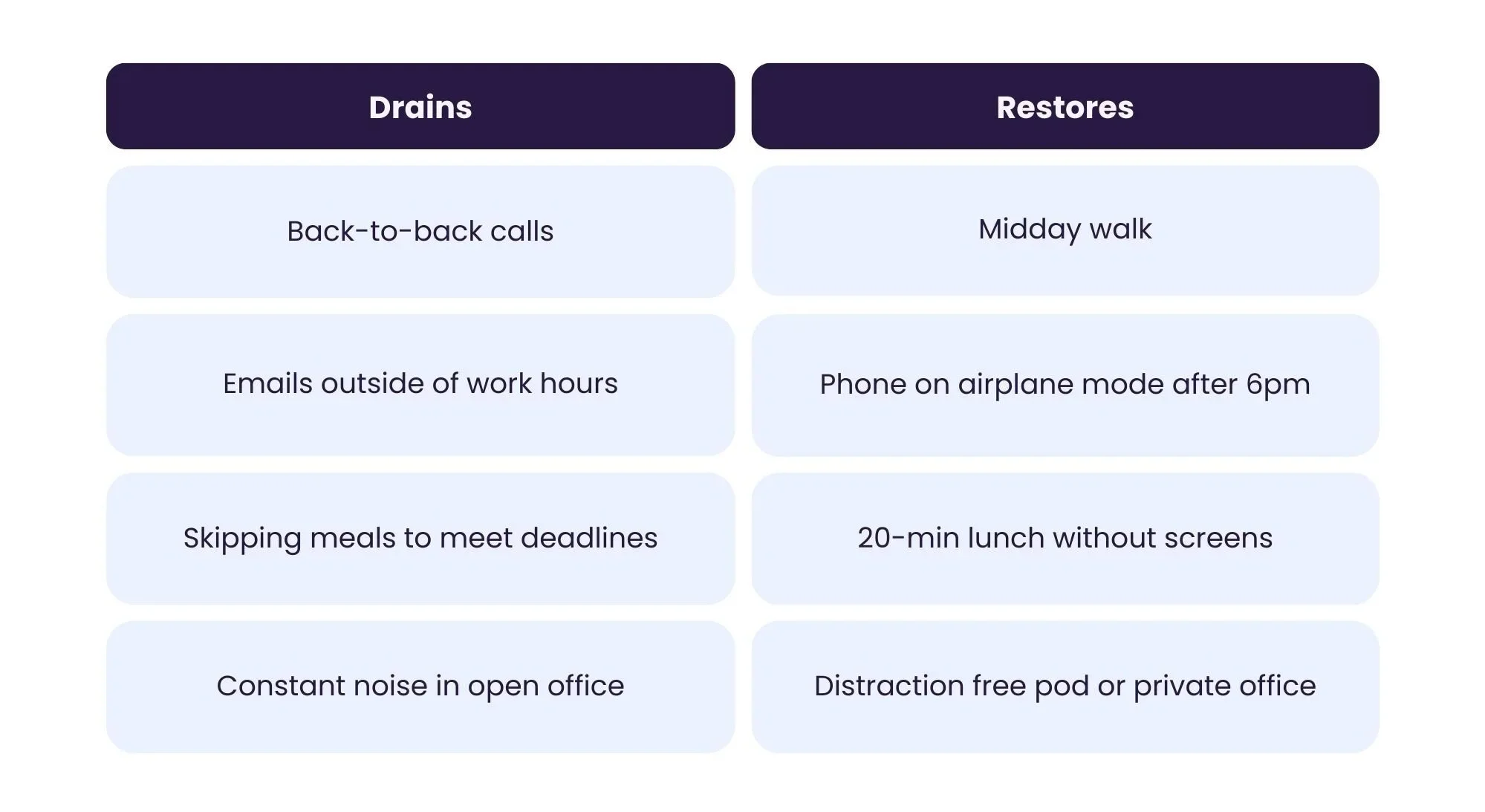
Step 1: Identify What Drains vs. What Restores
Create a simple working document with two columns:
Drains | Restores
Track for one week—without judgment. Include physical, mental, emotional, relational, and environmental factors.
Patterns emerge quickly. Triggers rarely stay hidden once you start paying attention.
Step 2: Capture Insight in Real Time
Burnout leaves clues.
Track moments of:
Resentment
Emotional hangovers
Cognitive shutdown
Dread or avoidance
Disproportionate exhaustion
These are data points—not character flaws.
Step 3: Set Boundaries You Can Actually Maintain
This is where most people fail by going too big, too fast.
Start with containment boundaries—those that stabilize you in the short term, even if the larger system hasn’t changed yet.
Examples:
Delaying responses instead of reacting immediately
Blocking lunch on your calendar
Reducing meeting frequency rather than eliminating meetings
Limiting emotional labor without severing relationships
Long-term, you may need structural boundaries: role changes, workload renegotiation, leadership conversations, or—yes—exiting environments that are incompatible with your health.
But containment comes first. You cannot make strategic decisions from a depleted state.
Step 4: Review and Refine Weekly
Burnout recovery is iterative.
A 15-minute weekly review helps you recalibrate:
What triggered me this week?
Which boundaries held?
Where did I override myself—and why?
What’s one boundary to reinforce next week?
Consistency—not intensity—is what changes your baseline.
The Leadership Cost of Ignoring Burnout Triggers
For senior leaders, unmanaged burnout doesn’t just affect personal health—it degrades leadership quality.
Chronic stress narrows perspective, reduces empathy, increases reactivity, and impairs judgment. Over time, it quietly undermines trust, culture, and strategic thinking.
Boundary-setting, then, is not a personal indulgence. It’s a leadership responsibility.
Organizations don’t fail because leaders care too much about boundaries. They fail when leaders burn themselves—and everyone else—out.
Final Thoughts
Burnout ends when tolerance ends.
Burnout is not resolved by vacations, wellness perks, or waiting for circumstances to change. It ends when you stop tolerating conditions that consistently violate your capacity.
Mapping your triggers gives you awareness. Defining your boundaries gives you leverage. Reinforcing them gives you your life back. Your energy is finite. Your nervous system keeps score. Your health is not collateral damage.
Burnout recovery isn’t about doing less. It’s about doing what actually restores you—on purpose, repeatedly, and without apology. And if you need support building that map? That’s not weakness. That’s strategy.
TL;DR – For the Chronically Overbooked
Burnout is caused by chronic stress, not a lack of grit.
Triggers are unique but often hide in plain sight: overcommitting, overfunctioning, under-recovering.
Boundaries are the antidote. You need time, communication, emotional, relational, and energetic ones.
Use a Drains vs. Restores working document to track patterns.
Reflect weekly. Practice boundaries daily. Refine as needed.
Burnout recovery isn’t about doing less. It’s about doing what actually restores you—on purpose.
Need Help? Burnout doesn’t always look like collapse.
Sometimes it looks like doing everything right… and still feeling awful. You don’t need more grit. You need a new game plan.💡 Let’s rebuild your energy without burning you out in the process.
Article References
The sources cited in the article:
American Psychological Association (APA). "Burnout and Stress Are Everywhere." APA - Burnout and Stress Are Everywhere
The NYTimes (NYT). “Your Body Knows You’re Burned Out.” NYT - Your Body Knows You’re Burned Out
PsychCentral. "Stress or Burnout: How to Tell Them Apart." PsychCentral - Stress or Burnout: How to Tell Them Apart
National Institutes of Health (NIH). "Loneliness and Social Isolation - Tips for Staying Connected.” NIH - Loneliness and Isolation
Research Gate(RG). “Stress and Burnout: The Significant Difference.” RG - Stress and Burnout: The Significant Difference
Harvard Business Review (HBR). “How Burnout Became Normal and How to Push Back Against It.” HBR - Burnout Became Normal